
If you look at the history of most sports, the objective is usually pretty clear. In soccer, you kick a ball into a net. In wrestling, you try to pin a guy to the floor. These are logical, primal activities.
Golf, however, defies logic. It is a game where the objective is to use a metal stick to hit a ball the size of a hailstone into a hole the size of a soup can, located four hundred yards away, while overcoming wind, gravity, water, sand, and your own crumbling self-esteem.
Nobody invents a game like that for fun. You invent a game like that because you have sinned and are seeking penance.
Historians will tell you that golf originated in 15th-century Scotland. But if you dig deeper into the psychology of the game, it becomes obvious that golf wasn’t “invented” as a sport. It was almost certainly the result of a drunk shepherd who spent an afternoon hitting a rock with a stick so as to avoid going home and doing chores and having to kiss their wife. (15th Century Scottish woman weren’t exactly Sydney Sweeney).
The Early Days: Sheep, Sticks, and Sorrow
The generally accepted theory is that bored shepherds in eastern Scotland used their crooks to knock stones into rabbit holes.
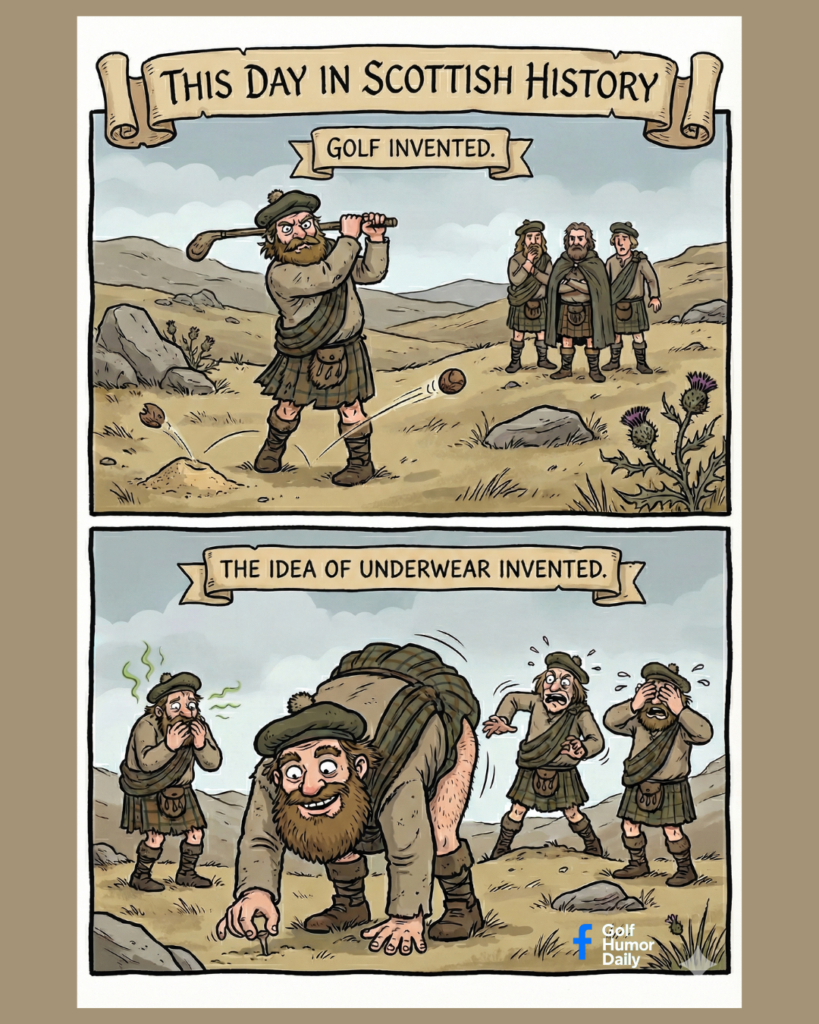
Think about that for a second. These men spent 14 hours a day staring at sheep— (maybe lustfully) but at animals that are essentially woolly clouds with zero personality—on the wind-blasted coast of the North Sea. They were cold, miserable, and likely hallucinating from a lack of vegetables. (The shepherds, not the sheep).
One day, a guy named Angus looked at a rock. He looked at a rabbit hole. And he thought, “I bet I can’t put that rock in that hole.” He swung. He missed. The rock went into a patch of thorns. Angus didn’t say, “Well, that was a silly idea.” No. Angus walked into the thorns, retrieved the rock,and tried again. That was the invention of the “breakfast ball.”
But also, at this moment, the spirit of golf was born: The irrational desire to pursue frustration at great personal expense.
The Royal Ban (The First “Golf Widow”)
By 1457, golf had become such a problem that King James II of Scotland actually banned it. His reasoning wasn’t that the game was stupid (though it was). His reasoning was that men were playing so much golf that they were neglecting their archery practice.
This is the first recorded instance of a government trying to regulate stupidity, and like all government regulations, it failed miserably. People ignored the ban.
They bought black-market clubs. They played in secret, like I sometimes have to do on Thursday men’s club night. Eventually, in 1502, King James IV—the grandson of the guy who banned it—bought his own set of clubs at the Ye Olde Richard’s Sporting Goods Store. He realized what every politician eventually realizes: If you can’t stop the people from wasting time, you might as well waste time with them.
The Evolution of Equipment: A History of Wallets Opening
For the first few centuries, golfers played with wooden balls. If you have never hit a wooden ball with a wooden stick, imagine hitting a croquet ball with a baseball bat, but the vibration travels directly up your arms and shatters your molars.
Then, in the 17th century, they invented the “Feathery.” This was a leather pouch stuffed with wet goose feathers. As the feathers dried, they expanded, and as the leather dried, it shrank, creating a rock-hard ball. The problem? A Feathery cost the modern equivalent of $20.
For one ball. And I get nervous hitting a Pro V-I over the lake at the Par 3 course I play on Orcahrd Mesa, here in Grand Junction, Colorado.
Twenty dollars. If you hit it too hard, it exploded. If it got wet, it fell apart. If you hit it with an “iron” club, you cut it open.
This established the second pillar of golf: Financial Ruin.
For 400 years, golf manufacturers have been promising us that technology will fix our game. First, it was the gutta-percha ball. Then the rubber core. Then the titanium driver. Then the adjustable weight track. Today, I can walk into a pro shop and buy a driver for $600 that was designed by aerospace engineers. It possesses a “variable thickness face” and “moment of inertia” technology. And I will still slice it into the exact same pond that Angus would have hit in 1457. The only difference is that my mistake cost me $4, and his cost him a goose dinner.
The Spread to America
Golf eventually jumped the pond to America, where we did what Americans do best: We made it comfortable, exclusive, and incredibly expensive.
The Scots walked. They played on rough, natural terrain where sheep kept the grass short. Americans looked at that and said, “No. We need perfectly manicured grass that requires millions of gallons of water. We need electric carts because walking is for peasants. And we need a beverage girl to bring us a Coors Light every three holes.”
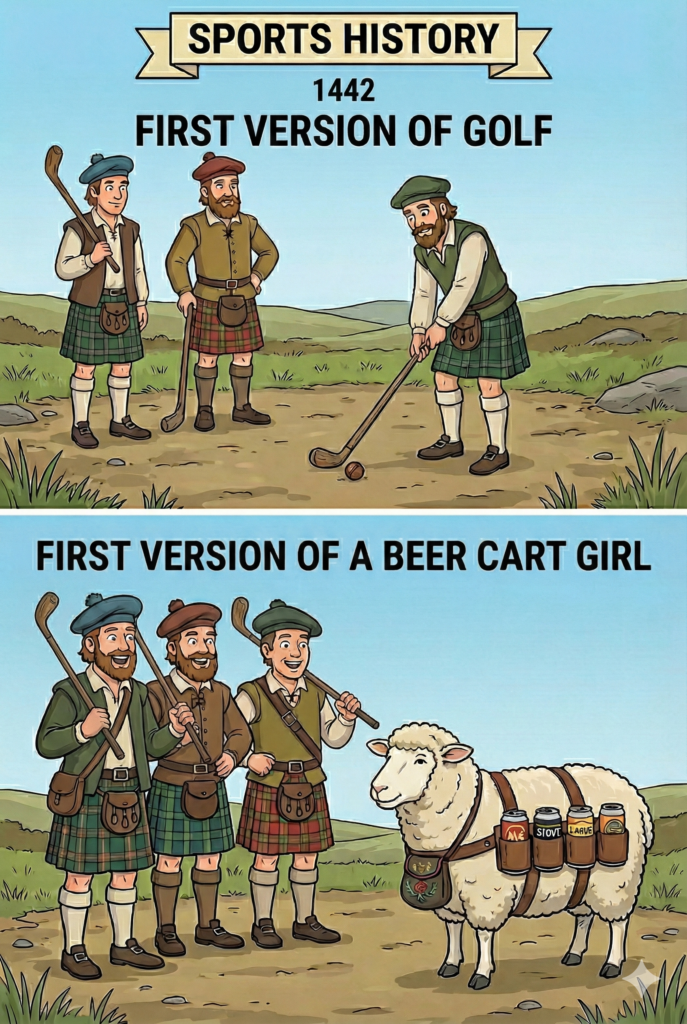
We also added the element of the “Country Club.” In Scotland, golf was a game for everyone. In America, we turned it into a status symbol. We built courses that require a membership fee equal to the GDP of a small nation, just so we can wear pastel pants and complain about the “pace of play” without having to look at poor people. I hope to be able to join one one, one day.
Why We Still Play
So here we are. Five hundred years later. We are still hitting a ball with a stick. We are still swearing at inanimate objects. We are still lustfully looking at sheep, or am I the only one?
Why play? Why do we subject ourselves to a game that is 90% failure? I think it goes back to Angus the Shepherd. It’s the hope. It’s that one shot.
You play 17 holes of absolute garbage. You lose three balls. You consider throwing your bag into a lake and taking up pickleball. But then, on the 18th fairway, you hit a 7-iron. It feels pure. It makes a sound like a cracking whip. The ball flies high and straight, landing three feet from the pin.
For exactly three seconds, you feel like a god. You forget the double-bogeys. You forget the $600 driver. You forget the sunburn. You turn to your buddy and say, “I think I figured something out with my swing.” You haven’t. You absolutely haven’t. But you’ll be back next Saturday to prove it.